 Dr. Harsh Vardhan Puri
 Call Us :
Hospital Address :
Medanta - The Medicity
CH Baktawar Singh Rd, Medicity, Islampur Colony, Sector 38, Gurugram, Haryana 122001
CH Baktawar Singh Rd, Medicity, Islampur Colony, Sector 38, Gurugram, Haryana 122001
Dr. Harsh Vardhan Puri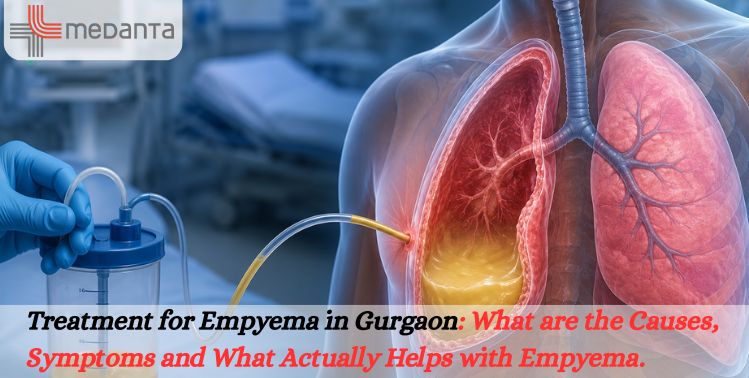
16 July, 2026
adminMost people who are told they have empyema do not know what it is. At first they are confused then they become scared when they understand what is happening. So I will explain it in terms. Empyema is when pus collects in the space between the lung and the chest wall. This usually happens after a chest infection that did not go away completely. If it is not treated the problem gets worse quickly.
People who search for empyema treatment in Gurgaon want to know what is happening in their chest. They also want to know what will happen next.
It usually starts with pneumonia. The infection spreads to the space, between the lung and the chest wall. Of getting better it turns into a pocket of infected fluid that becomes pus over time. This can take days or weeks to happen. Empyema is a condition that needs to be treated. A few other paths lead there too —
Not every pneumonia case ends up like this, obviously. But weak immunity, uncontrolled diabetes, or simply waiting too long before treating that original infection — these tend to push the risk up.
If you have a chest infection that is not getting better when it should or the symptoms are getting worse or getting better that is the time to see a doctor and get a proper check up. A chest infection is a thing and you need to make sure it is treated properly. If the chest infection is still bothering you after a time or the symptoms are getting worse you should go to the doctor. The doctor will be able to check you and give you the right treatment for the chest infection. Not wait another week hoping it fixes itself.
Usually starts with a plain chest X-ray, which is often enough to spot fluid sitting around the lung. A CT scan follows when more clarity is needed — how much fluid, exactly where it’s sitting. Most of the time doctors will also do a pleural fluid tap, pulling out a small sample with a needle and sending it off to the lab. This step matters more than patients realise, because it tells us which bacteria we’re actually up against, and that decides the whole treatment plan from there.
Antibiotics come first, no exceptions. Once the fluid’s tested, patients are started on antibiotics matched to the specific bacteria found. Caught early enough, this can sometimes do the whole job on its own.
Chest tube drainage is the next step if the pus has already thickened, or if antibiotics alone aren’t getting through it. A tube goes into the chest and drains the infected fluid out directly. Pretty standard procedure, and most patients notice a real difference in breathing within a day or two.
VATS — Video-Assisted Thoracoscopic Surgery — comes after that. When there’s thick pus sitting around, multiple fluid pockets, or the lung’s starting to get trapped by scar tissue, this minimally invasive surgery clears it all out through a few small incisions with a camera guiding the surgeon. Much easier recovery for the patient compared to open surgery.
Open surgery, decortication, is kept for the more advanced or long-running cases, where that thickened infected lining around the lung has to be physically peeled away so the lung can expand properly again. Most patients never end up needing this, but delayed or chronic cases sometimes leave no other route.
Which of these ends up being right really depends on how far along things are by the time it’s caught. Better to get properly evaluated than assume one treatment fits everyone.
Left alone, empyema moves through stages — starts as a simple infected fluid collection, thickens over time, and eventually forms a fibrous layer that traps the lung entirely. If you catch the infection early the doctor will probably give you antibiotics. Do a simple procedure to drain it.. If you wait too long you will probably need to have surgery and the infection will take a lot longer to heal. The recovery from surgery is a lot harder. It takes much longer to get better, from the infection. That’s really the whole reason doctors keep pushing patients not to sit on symptoms.
Gurgaon’s hospital setup has come a long way these past several years. Many hospitals in this city now do VATS and other advanced thoracic surgeries. These are the surgeries that you had to travel to another city for a few years ago. If you are looking for Empyema Treatment in Gurgaon you can get the kind of surgical care that you would get at the big hospitals in the major cities. This is a deal because Empyema Treatment in Gurgaon is now available right here. You do not have to go to another city to get Empyema Treatment in Gurgaon. The doctors here are just as good as the doctors at the hospitals.
Delhi, right next door, offers much the same. Many patients like to compare options before making a decision, which’s fair. When it comes to Empyema Treatment in Delhi and Gurgaon they usually have specialists and hospital networks. This is because the cities in NCR are closely connected. What is more important than the city is finding a good thoracic specialist. This specialist should have a lot of experience with infections. Not every doctor who treats chest problems sees cases of empyema often. So it is really important to find a thoracic specialist who regularly treats Empyema cases.
Recovery timelines swing quite a bit depending on how advanced things were at diagnosis. Patients caught early with antibiotics or a simple chest tube are usually back to normal life within a couple of weeks. Those needing VATS or open surgery take longer — sometimes a few weeks, sometimes closer to two months — before lung function’s fully back. Breathing exercises and physiotherapy usually get added into recovery too, to help the lung expand fully again.
Can it come back after treatment? Rare, if treated properly and the infection’s fully cleared out. Incomplete drainage, or stopping antibiotics too soon, is usually what brings it back.
Does everyone need surgery? No. A lot of early cases respond fine to antibiotics plus simple drainage. Surgery only really comes into play when pus gets thicker or antibiotics are not working anymore.
How long does a chest tube usually stay in? Well it usually stays in for a day to about two weeks. It really depends on how the fluid goes away and the lung gets better. The lung needs to re-expand. It typically takes a day to two weeks for that to happen.
Is empyema just pneumonia by another name? No. It’s often a complication of pneumonia that wasn’t fully treated, but they’re not the same thing — pneumonia is the lung infection itself, empyema is the pus collecting around the lung afterward.
Empyema doesn’t resolve on its own, however long you wait it out. Catch it early, treatment stays simple. If chest infection symptoms are hanging around longer than they should, seeing a thoracic specialist sooner rather than later is usually what separates a quick recovery from a much rougher one.
Category : Empyema , Empyema Treatment