 Dr. Harsh Vardhan Puri
 Call Us :
Hospital Address :
Medanta - The Medicity
CH Baktawar Singh Rd, Medicity, Islampur Colony, Sector 38, Gurugram, Haryana 122001
CH Baktawar Singh Rd, Medicity, Islampur Colony, Sector 38, Gurugram, Haryana 122001
Dr. Harsh Vardhan Puri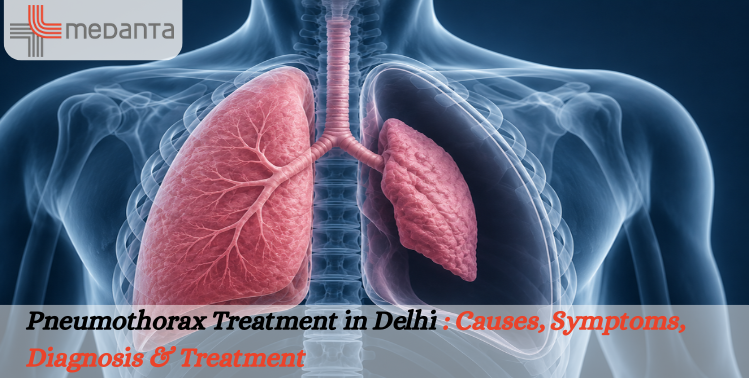
28 July, 2026
adminA collapsed lung can be really scary. Sometimes it is very serious. Doctors call it Pneumothorax when air gets into the space between the lung and the chest wall. This builds up pressure. Can make part of the lung collapse. It can even make the lung collapse. This can happen to a healthy young person for no reason. It can also happen after an injury. If someone already has a lung disease. Sometimes it can even happen after a medical procedure that did not go exactly as planned.
People looking for Pneumothorax Treatment in Delhi are usually in one of two situations. They might have just been. I want to know what to do next.. They might have had a collapsed lung before and want to know how to stop it from happening again. Either way there are some things that’re good to know.
There are types of collapsed lungs. The cause is different for each type.
Chest pain plus sudden breathlessness together isn’t something to wait out at home, ever. Even a mild pneumothorax needs to be checked because there is genuinely no way to figure out from the symptoms of pneumothorax alone how much of the lung of pneumothorax has actually collapsed.
Physical examination
Chest X-ray
CT Scan
Oxygen saturation test
Observation works for very small pneumothoraxes with mild or no symptoms at all. The body just reabsorbs the air on its own over a few days, with repeat X-rays confirming it’s shrinking rather than growing.
Needle aspiration comes in for moderate cases — a needle goes into the chest to pull the trapped air out directly, relieving pressure without needing anything more involved.
Chest tube drainage is for larger or repeat pneumothoraxes. A tube is placed into the chest cavity, hooked up to a drainage system, and air keeps escaping continuously until the lung fully re-expands. Most patients are in hospital a few days while this plays out.
VATS — Video-Assisted Thoracoscopic Surgery — gets considered once it’s become a recurring problem, or the first episode was serious enough that another one seems likely. Through a few small incisions, the surgeon seals the leak and, if needed, removes the weak patches of lung tissue (called blebs) causing the trouble in the first place. Minimally invasive, and recovery’s noticeably quicker than open surgery.
Pleurodesis sometimes gets done alongside VATS — basically making the lung stick to the chest wall on purpose so there’s no space left for air to collect again. Usually kept for patients who’ve had this happen more than once.
One thing that surprises a lot of patients — how often this comes back if the underlying cause never gets addressed. A first episode might settle with simple observation or a chest tube, sure, but skip treating the weak spots in the lung tissue and there’s a real chance it happens again, sometimes within a few months. This is usually where doctors start bringing up VATS or pleurodesis rather than just handling each flare-up as it shows up.
Delhi’s hospital network has some of the country’s more experienced thoracic teams, set up to handle everything from a straightforward first-time pneumothorax to the messier, recurring cases that need VATS. That’s a big reason patients travel in from across North India specifically for this.
Gurgaon isn’t lagging much either. Several hospitals here run solid thoracic surgery programs with the same VATS and minimally invasive capabilities you’d find at the bigger Delhi centres. So whether it’s Pneumothorax Treatment in Delhi or Pneumothorax Treatment in Gurgaon someone’s looking up, they’re generally tapping into the same pool of surgical expertise — the NCR region shares a fairly tight network of specialists across both cities anyway.
A big part of how well a pneumothorax case turns out comes down to the surgeon handling it — someone who’s actually dealt with recurring, complicated cases before, not just the routine ones. Dr. Harsh Vardhan Puri is a name that comes up often in this space. He is among India’s National Board-certified thoracic surgeons and he holds the Presidents Gold Medal in the specialty of thoracic surgery which is a recognition that not many surgeons across the country can claim to have.
He completed his MBBS at Government Medical College in Jammu. Then he went to Sir Ganga Ram Hospital for training. At Sir Ganga Ram Hospital he finished his DNB in General Surgery. After that he finished his DNB in Thoracic Surgery. Then he went to Toronto General Hospital in Canada for -speciality training in Thoracic Surgery and Lung Transplantation. Toronto General Hospital is one of the respected centers in the world for this kind of work.
Today he works as a Senior Consultant in Thoracic Surgery and Lung Transplantation at Medanta. The Medicity in Gurugram. He has been a part of thousands of thoracic procedures over a career that spans more than a decade. His work includes all kinds of thoracic conditions such as pneumothorax and lung cancer and empyema and complex lung transplant cases. He uses both minimally invasive approaches, like VATS and robotic surgery to treat thoracic surgery conditions and lung transplantation cases.
Can pneumothorax happen again after treatment? Yes, particularly if the first episode was managed conservatively without touching the underlying weak spots in the lung. It’s exactly why recurring cases get steered toward VATS or pleurodesis instead of another round of observation.
Is a collapsed lung always an emergency? Not always, but it should always be checked urgently regardless. Small pneumothoraxes can sometimes be managed with observation, but a tension pneumothorax is a genuine emergency needing immediate treatment.
How long does recovery take after a chest tube or VATS? Chest tube patients are usually up and moving within a few days once the lung’s re-expanded. VATS recovery generally takes a couple of weeks before things are back to full normal activity.
Can pneumothorax happen without any lung disease at all? Yes — primary spontaneous pneumothorax shows up in people with otherwise healthy lungs, often young, tall, thin individuals, and sometimes with no clear trigger whatsoever.
Does smoking raise the risk? Quite significantly, for certain types of pneumothorax, it also pushes up the odds of recurrence after treatment.
If you are looking for Pneumothorax Treatment in Delhi, early diagnosis and treatment by an experienced thoracic surgeon can help prevent complications and reduce the risk of recurrence. Seeking timely medical care ensures better recovery and long-term lung health.
Category : Pneumothorax