 Dr. Harsh Vardhan Puri
 Call Us :
Hospital Address :
Medanta - The Medicity
CH Baktawar Singh Rd, Medicity, Islampur Colony, Sector 38, Gurugram, Haryana 122001
CH Baktawar Singh Rd, Medicity, Islampur Colony, Sector 38, Gurugram, Haryana 122001
Dr. Harsh Vardhan Puri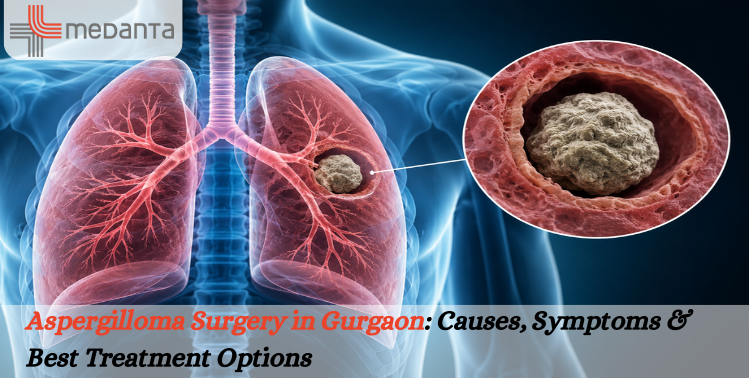
27 July, 2026
adminMost people have never heard of aspergilloma until a scan throws up the word and suddenly they’re googling it at midnight. It’s a fairly specific condition — a ball of fungus, usually Aspergillus, that forms inside an existing cavity in the lung. Not something that shows up in a healthy lung out of nowhere. It needs a pre-existing space to grow in, which is why it’s almost always linked to old TB scars, healed lung abscesses, or cavities left behind by other lung diseases.
Patients searching for Aspergilloma Surgery in Gurgaon are usually past the confusion stage already — they’ve had the scan, heard the word from their doctor, and now want to know what actually needs to happen next. So let’s get into that.
The fungus Aspergillus is around us all the time, honestly, floating in the air we breathe. Most healthy lungs deal with it without any issue. But if there’s already a cavity sitting in the lung — most commonly from a healed TB infection, but also from conditions like sarcoidosis, bronchiectasis, or a previous lung abscess — that space becomes an easy spot for the fungus to settle into and grow. Over time, it forms a rounded mass, often visible on imaging as what doctors call a “fungus ball,” sometimes with a crescent of air around it that’s fairly distinctive on a CT scan.
India, given how common TB still is, sees a fair number of these cases. It’s one of the reasons thoracic surgeons here end up dealing with aspergilloma more often than doctors in countries where TB isn’t as widespread.
A CT scan of the chest is really the backbone of diagnosis here — it shows the fungal ball sitting inside the cavity, often with that characteristic air crescent around it. Blood tests checking for Aspergillus antibodies can support the diagnosis further. In some cases, sputum tests or bronchoscopy are used too, particularly if there’s any doubt about what’s actually going on inside that cavity.
Here’s the thing with aspergilloma — antifungal medication alone usually doesn’t do much. The fungal ball sits inside a cavity that doesn’t have great blood supply, which means medicines struggle to reach it effectively. That’s why surgery ends up being the main treatment path for most symptomatic cases, especially once there’s been any episode of coughing blood.
Surgical resection is the standard approach — removing the affected part of the lung along with the fungal ball itself. Depending on the extent of lung involvement, the procedure may involve a wedge resection (removing the affected portion of the lung), a lobectomy (removing an entire lobe), or, in more advanced cases, a more extensive surgical resection.
Bronchial artery embolisation is sometimes used first, particularly in patients who are actively bleeding or too high-risk for immediate surgery. This procedure blocks off the
blood vessel that’s causing the bleed, stabilising the patient before a more definitive surgical plan is made.
VATS (Video-Assisted Thoracoscopic Surgery) is increasingly the preferred technique where feasible — smaller incisions, quicker recovery, less trauma to the chest wall compared to open surgery. Not every case is suitable for it though; scarring from old TB or extensive disease sometimes makes open surgery the safer, more practical route.
Surgery for aspergilloma isn’t considered routine or low-risk, to be clear. The lung tissue around old TB cavities tends to be scarred and stuck to the chest wall, which makes these operations more technically demanding than a standard lung resection. This is exactly why experience matters so much when choosing a surgeon for this particular condition.
Waiting on aspergilloma, especially once bleeding has started, isn’t really a safe strategy. Even a small bleed today can turn into a much larger, dangerous one later, and the risk doesn’t go down on its own with time — usually the opposite. Patients who get evaluated and treated early, before repeated bleeding episodes or worsening lung damage, generally have a smoother surgical course and recovery.
Gurgaon’s thoracic surgery centres have kept pace with the more advanced procedures this condition often needs, including VATS-based lung resections and embolisation support for high-risk bleeding cases. Given how technically demanding these procedures can be—especially in lungs scarred by previous tuberculosis (TB)—it’s important to choose a thoracic surgeon with extensive experience in managing aspergilloma cases rather than one who primarily performs routine lung resections.
Delhi-NCR as a whole has a strong concentration of thoracic specialists experienced with this exact kind of complex, TB-related lung surgery, and Gurgaon’s hospitals draw from largely the same pool of expertise.
Cases like aspergilloma — where old TB scarring and active bleeding risk both come into play — really call for a surgeon who’s comfortable with the more technically complex end of thoracic surgery. Dr. Harsh Vardhan Puri ranks among India’s first National Board-certified thoracic surgeons and earned the President’s Gold Medal in the specialty during his training, reflecting the depth of his surgical expertise.
He completed his MBBS at Government Medical College, Jammu, followed by his DNB in General Surgery and later DNB in Thoracic Surgery at Sir Ganga Ram Hospital. He then went on to complete super-speciality training in Thoracic Surgery and Lung Transplantation at Toronto General Hospital in Canada. He currently practices as a Senior Consultant in Thoracic Surgery and Lung Transplantation at Medanta — The Medicity, Gurugram, where his work covers a wide range of complex thoracic conditions, including TB-related lung disease, aspergilloma, lung cancer, empyema, and lung transplantation, using both open and minimally invasive techniques such as VATS and robotic surgery.
Can aspergilloma be treated with medicines alone, without surgery? Rarely effectively. Antifungal drugs don’t penetrate the fungal ball well because of poor blood supply inside the cavity, which is why surgery remains the main treatment for symptomatic cases.
Is coughing up blood always serious with aspergilloma? It should always be taken seriously and evaluated promptly, even if it starts small. It can escalate unpredictably, and that unpredictability is exactly why doctors don’t recommend waiting it out.
How risky is aspergilloma surgery compared to other lung surgeries? It tends to be more technically demanding because the surrounding lung tissue, especially near old TB cavities, is often scarred and adhered to the chest wall. This is why choosing a surgeon experienced specifically with this condition matters.
Is VATS always possible for aspergilloma? Not always. It depends on how much scarring and disease extent there is. Some cases are well-suited to VATS, while others, especially with extensive old TB damage, need open surgery for safety.
Does having TB in the past mean I’ll definitely get aspergilloma? No. Most people who’ve had TB never develop aspergilloma. It only forms if a residual cavity remains
after healing and later gets colonised by the fungus, which happens in a relatively small proportion of cases.
If you’re looking for Aspergilloma Surgery in Gurgaon, early evaluation by an experienced thoracic surgeon can help prevent serious complications such as recurrent bleeding and improve treatment outcomes. Choosing the right specialist at the right time often makes a significant difference in recovery.
Category : Aspergilloma Surgery