 Dr. Harsh Vardhan Puri
 Call Us :
Hospital Address :
Medanta - The Medicity
CH Baktawar Singh Rd, Medicity, Islampur Colony, Sector 38, Gurugram, Haryana 122001
CH Baktawar Singh Rd, Medicity, Islampur Colony, Sector 38, Gurugram, Haryana 122001
Dr. Harsh Vardhan Puri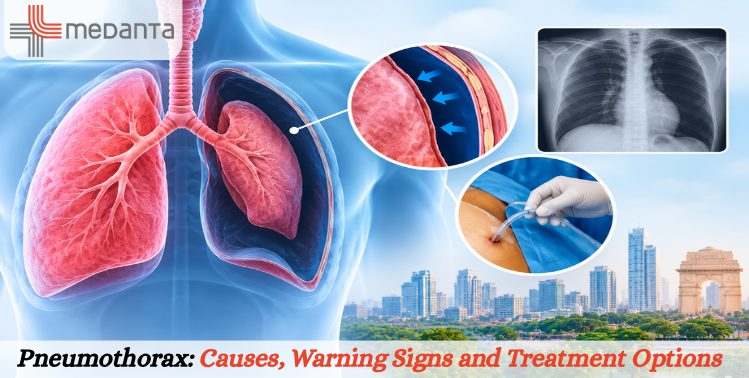
26 October, 2026
adminPneumothorax, commonly known as a collapsed lung, occurs when air enters the pleural space between the lung and the chest wall. The trapped air can put pressure on the lung and cause it to partially or completely collapse.
The condition can range from a small pneumothorax that is monitored carefully to a life-threatening emergency requiring immediate treatment.
Possible causes include:
Smoking increases the risk of spontaneous pneumothorax. Some cases occur without an obvious underlying cause.
Common symptoms include:
Symptoms may appear suddenly. Severe breathing difficulty, faintness or rapidly worsening chest pain requires emergency medical attention.
A doctor may perform a physical examination and recommend a chest X-ray or ultrasound. A CT scan may be required in selected cases to clarify the diagnosis or identify underlying lung abnormalities.
Treatment depends on the size of the pneumothorax, the patient’s symptoms, the underlying cause and overall clinical stability.
Possible approaches include:
A large or unstable pneumothorax may require urgent intervention.
Surgery may be considered when pneumothorax recurs, an air leak persists or certain underlying lung abnormalities are present.
Video-assisted thoracoscopic surgery (VATS) is a minimally invasive technique that may be used in suitable patients. The procedure can address the source of the air leak and help reduce the risk of recurrence.
A collapsed lung should always be medically assessed. Early diagnosis helps determine the severity of the condition and the safest treatment approach.
About the Author: Dr. Harsh Vardhan Puri is a Senior Consultant Thoracic Surgeon & Lung Transplant Surgeon at Medanta – The Medicity Hospital, with expertise in the evaluation and surgical management of thoracic conditions.
Category : Pneumothorax